The World Cup Intelligence Report: Belief
The World Cup Sentiment Market is Open

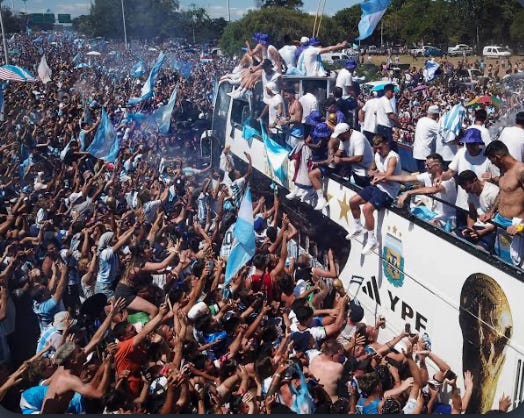
Most World Cup previews start with squads, odds, fixtures, tactics.
All useful. All incomplete.
Before the first whistle, another market is already open: belief.
I pulled X and media sentiment across all 48 teams to see what fans, local reporters, diaspora accounts, and football obsessives are already buying before kickoff. Not with money. With attention.
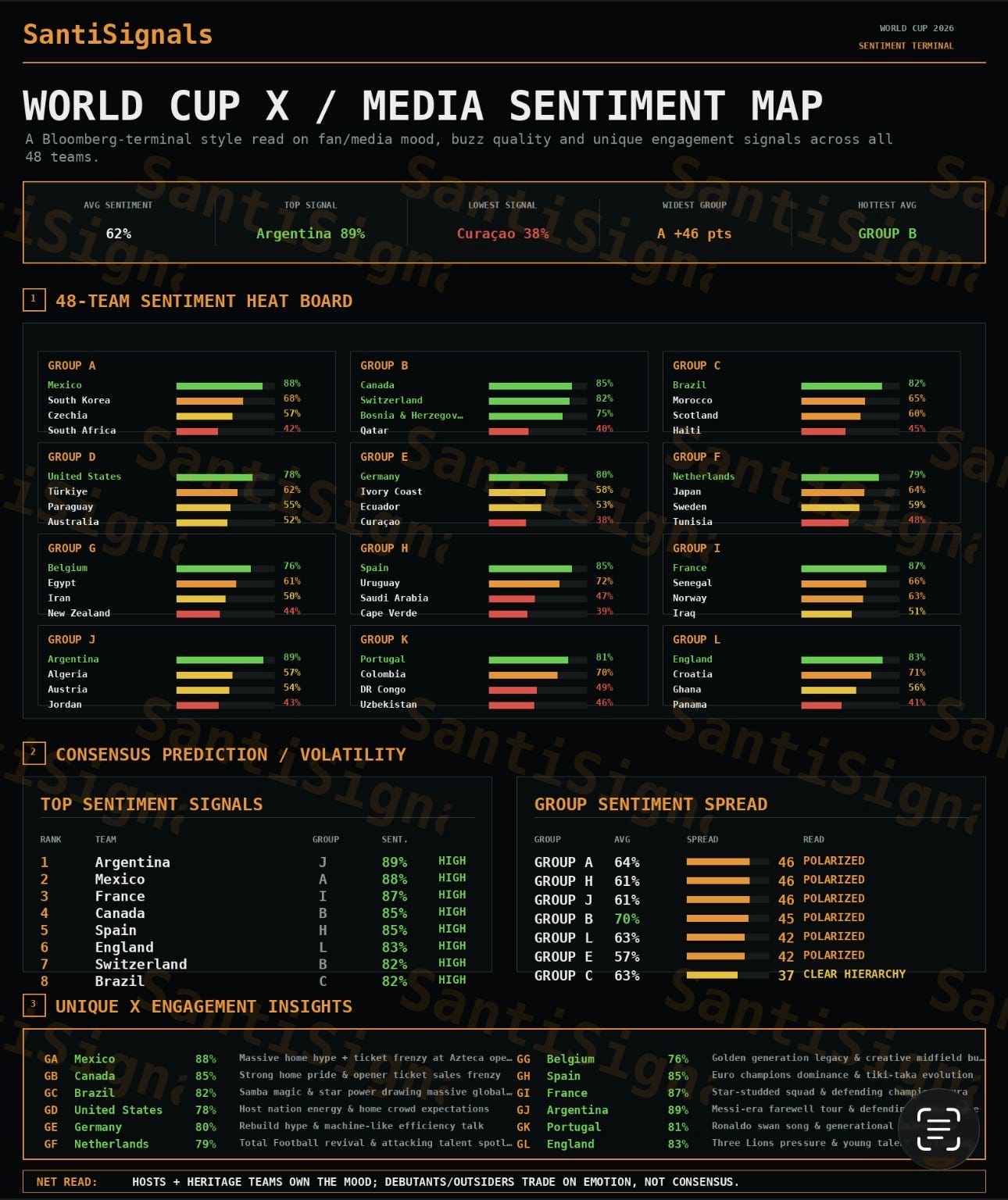
And attention is not nothing.
World Cups are story machines. Football decides the results, but the pre-tournament market gets built out of pressure, identity, diaspora energy, farewell tours, host-country expectation, and whatever narrative goes liquid first.
The crowd is emotional, biased, noisy, nationalistic, nostalgic, and often completely wrong.
Great.
That is the data.
The question is not only: who is good?
It is:
What has the crowd already marked up?
The hosts are carrying three different trades
The three host countries all have positive sentiment. But they are not trading the same way.

Mexico is the loudest. The Azteca opener is doing a lot of work: ticket frenzy, home pride, and the sense that this tournament should mean something bigger than simply getting out of the group.
That is pressure with a home crowd attached.
Canada feels cleaner. The mood is less “we should go deep” and more “we belong here.” Co-host pride, stadium buzz, and fast-selling tickets are doing the work.
The United States is the most complicated. Positive sentiment, but with a receipt attached. Home soil. Young talent. Now prove it.
So the host premium splits three ways:
Mexico: romance plus pressure.
Canada: arrival plus belief.
U.S.: expectation plus scrutiny.
“Host nation” sounds like one variable. It is not. It is three different forms of emotional leverage.
Underdogs are trading on identity
Some teams are being priced less as football teams and more as identity vehicles.
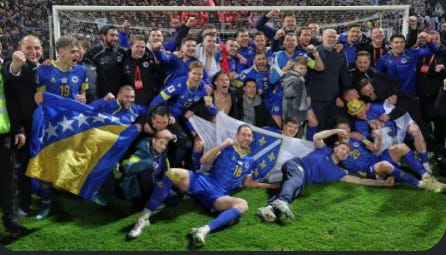
Bosnia & Herzegovina is the cleanest example. The dominant mood is excited underdog. A lot of the energy is diaspora-driven, especially in North America. The tournament feels less neutral for them than the draw suggests.
That matters because Bosnia are also one of the best stress-test teams in the field. They are live enough to believe in, but their physical burden profile is brutal given they will travel more than any other team in the group stages by far. Belief is rising. The road tax is real.
That is the trade.
Scotland is another version. The Tartan Army is basically the asset. Singing, travel, emotion, the whole “we are here and you will hear us” thing. You can argue about the team. You cannot argue about the presence.
Haiti, Cape Verde, Curaçao, Uzbekistan, and Jordan all have some version of the rare-stage trade. People want the story before the team has proved it can carry the story.
That does not make the story wrong.
It just means affection and probability are different instruments.
Underdogs do not need consensus to get heat.
They need identity.
Legacy is the most liquid narrative
Some players are bigger than their teams’ sentiment dashboards.
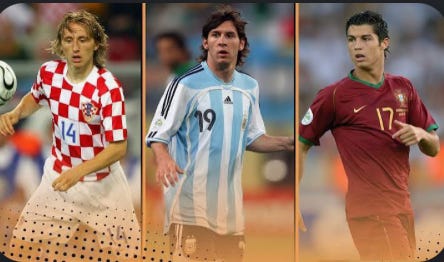
Messi is the obvious one. Argentina are being priced as defending champions, but also as the possible final chapter of the Messi World Cup story.
People are asking whether Argentina can win. They are also asking whether the ending can be right.
Those are different questions. The second one has more buyers.
Ronaldo does something similar for Portugal. The squad is strong enough to analyze normally, but the conversation still bends around the last dance.
Modrić gives Croatia the quieter version: less frenzy, more reverence. Croatia’s sentiment is not viral; it is respectful. One more tournament with a player people do not quite want to let go.
Legacy gives neutral fans a reason to care.
It can also make people confuse the ending they want with the team that exists.
Quiet respect may be mispriced
The loudest teams are not always the most interesting.
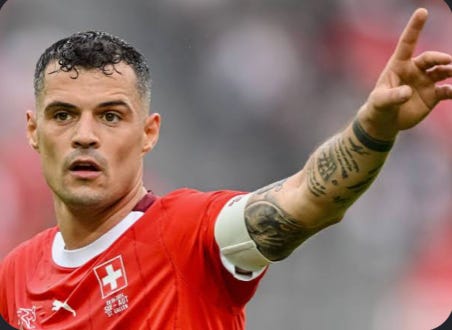
Switzerland are the classic quiet-respect team. Nobody wants to make them the protagonist. Nobody is building a romantic case. But the mentions are steady, professional, and mostly positive. Switzerland are boring in exactly the way that tends to survive tournament football.
Czechia are similar: structure, set pieces, physicality, not much hype.
Ecuador get the same kind of respect. Disciplined. Awkward. Unpleasant to play.
Japan might be the best version of this signal. Tactical accounts rate them. The appreciation is more informed than emotional: organization, speed, counter-attacking threat, game-state discipline.
This is probably the cleanest sentiment bucket.
Loud hype can outrun the football.
Quiet respect usually means the story has not gotten expensive yet.
Africa is not one sentiment trade
It is easy to flatten African teams into one “passionate support” bucket. The X read is more interesting than that.
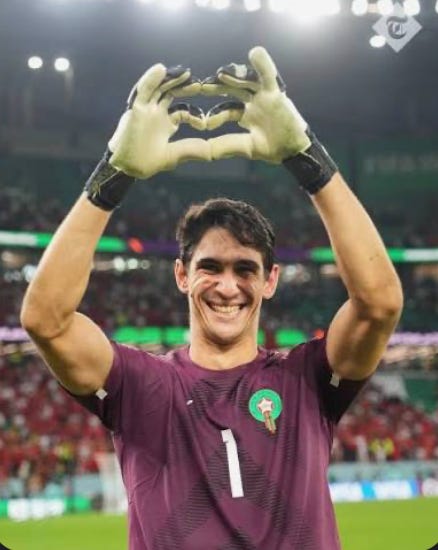
Morocco have legitimacy. The dark-horse talk is no longer just vibes. Recent tournament success changed the way people price them.
Senegal have ceiling. A lot of fans see them as Africa’s best bet.
Ivory Coast have athleticism and flair.
Ghana have revival energy.
DR Congo have fun-watch upside.
South Africa have classic underdog grit: Bafana support, jokes about brutal kickoff times, and belief in a surprise.
That is a map, not a single sentiment.
Morocco is legitimacy.
Senegal is ceiling.
South Africa is grit.
Ivory Coast and DR Congo are athletic entertainment.
Low energy is information too
A weak sentiment score is not automatically bearish. Sometimes people are simply not paying attention yet.
But sometimes the crowd sees no reason to care.
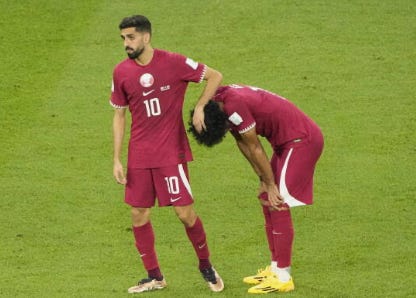
Qatar has one of the weakest fan-energy signals. Most of the conversation frames them as the soft spot in Group B.
Saudi Arabia has curiosity, but not much conviction.
Panama has CONCACAF pride, but limited global volume.
New Zealand gets underdog warmth, not much heat.
There are two kinds of low sentiment.
One is quiet value.
The other is just silence.
The trick is knowing which one you are looking at.
That’s the market map. Below is the paid tape: the full group-by-group sentiment read, plus the teams where the crowd looks too loud, too quiet, or misplaced against the model path, plus the information you can trade on, whether you’re playing Fantasy or placing bets.
